
Why Criterix exists
Criterix takes medication safety seriously. Problems are evaluated and solutions are created by the people who are actually watching the errors occur in real time.
Criterix recognizes that all-tech and all-paper healthcare environments both leave gaps, and that those gaps close when humans, paper and tech work together. Sometimes a high-tech problem is solved with a low-tech answer, and vice versa. That insight led to the development of a paper book that works as an adjunct to, rather than a replacement for, the electronic records that have become a vital pillar of the healthcare system.
The same founding principle of the Criterix AI clinical support tool, that all data should be easily traced to the source, is the premise behind the Criterix medication index book, What I Take, and Why.
Medication safety, built by the people who watch the errors happen.
Tools that keep patient information traceable to its source, so an error is found early, during the reconciliation process, rather than after the onset of potentially irreversible consequences.
Where medications fall through the care gap, Criterix builds a bridge.
Anyone who has strung up holiday lights wired in series knows the frustration: one bad bulb and the whole string goes dark.
Parallel wiring took over because when one bulb fails, it is the only one that goes out. You can see exactly where the problem is.
Medication errors work the same way. In a series system, one mistake follows the patient from the moment it is made until the consequences are obvious, sometimes months later, and clinicians have to dig back through months of documentation to find where it started. Criterix products, high-tech and low-tech alike, are built like a parallel circuit. Every piece of information is traceable to its source, so an error can be caught at the next point of care and traced back to where it began, instead of being carried forward.
Which patient chart would you rather troubleshoot?
Each bulb is one transcription in the EMR. Without the book, finding a dropped medication means searching every note in the chart. With it, you can see exactly which bulb went out.
See it happen. A home care nurse compares the book to a discharge list, spots the missing Lasix, and gets it back before it causes harm.

What I Take, and Why
Large Print and Pocket Editions
Eliminates medication name and dose transcription errors by eliminating transcription.
Your medication information travels from your prescriber, to your pharmacy, to this book, with no one copying it by hand along the way.
How to build the book
Co-branded editions
A private edition of What I Take, and Why, printed with your organization’s name and contact page, for health systems, law firms, medical practices, home-care agencies, and senior living communities.
Common concerns and objections, answered
-
They don’t fill it out. The pharmacy label goes in at each fill, and the patient or caregiver adds the reason and any changes; the prescriber only confirms the entries during the medication teaching a visit already includes. Even before a word is written, the labels beat the scrap-paper list most people arrive with: complete, legible, each carrying its pharmacy’s and prescriber’s name and number, and refreshed at every refill.
-
It is an adjunct, not a replacement. Fill history and siloed records miss what the book captures: a dose lowered without a new prescription, which fill history still shows at the old dose; a prescription paid in cash or filled outside the network, which may never reach the system; a transcription error carried forward from the last visit; and a medication stopped over cost, which looks intentional but needs reordering. The book records these in writing, dated, sourced, and traceable.
-
It is not meant to be trusted blindly. The clinician still verifies each medication against the pharmacy label and the phone number printed on it. The handwriting adds the reasoning and the changes, the context that matters most when the electronic data is incomplete or unavailable, such as an after-hours admission across health systems.
-
The patient or caregiver is the author; the prescriber only confirms that what is written matches what they ordered. Nothing is signed, and the book stays in the patient’s possession. It works like any medication list a patient brings to a visit, as patient education, not a shadow chart.
-
At admission, the book is photocopied or scanned and handed back, so a dated snapshot stays in the chart even if the book goes home. Clinicians already reach for patient-brought lists when the record does not add up; this is a better version of a source they use.
-
It is not meant to last forever. Labels are refreshed at every refill, stopped medications become history, and the patient keeps a photo or photocopy. A worn book is replaced every year or two, carried alongside the old one until everything transfers over.
-
The only recurring task is placing the new label at each refill: no transcription, no medical knowledge. The book grows more useful as it fills, and for the caregiver juggling several specialists who do not share records, even a partly kept book beats the nothing they have now.
-
The book is not a live inpatient record. Temporary changes go on sticky notes the patient carries to the next transition, so a discrepancy at discharge, such as a held medication missing from the discharge list, gets questioned instead of missed.
A low-tech answer to a high-tech problem. Every prescription traceable to its source, with a human in the loop.
Three different people, three different problems, three different plans.
Open each case in order: the note that comes in, the options Criterix ranks, and the note the prescriber reviews and signs.
Case 1: A fictional 54-year-old man with treatment-refractory schizophrenia
Case 2: A fictional older adult with a prolonged QTc and acute agitation
Case 3: A fictional adult with an active infection and new acute agitation
WRITING
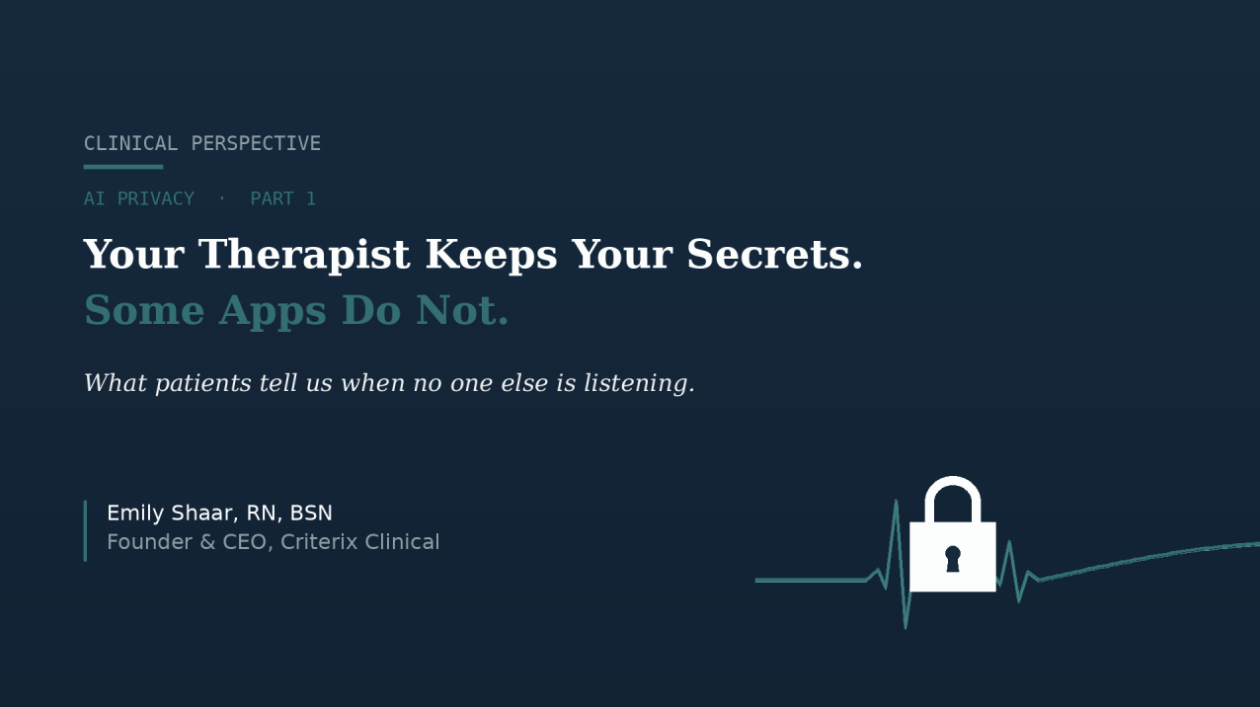
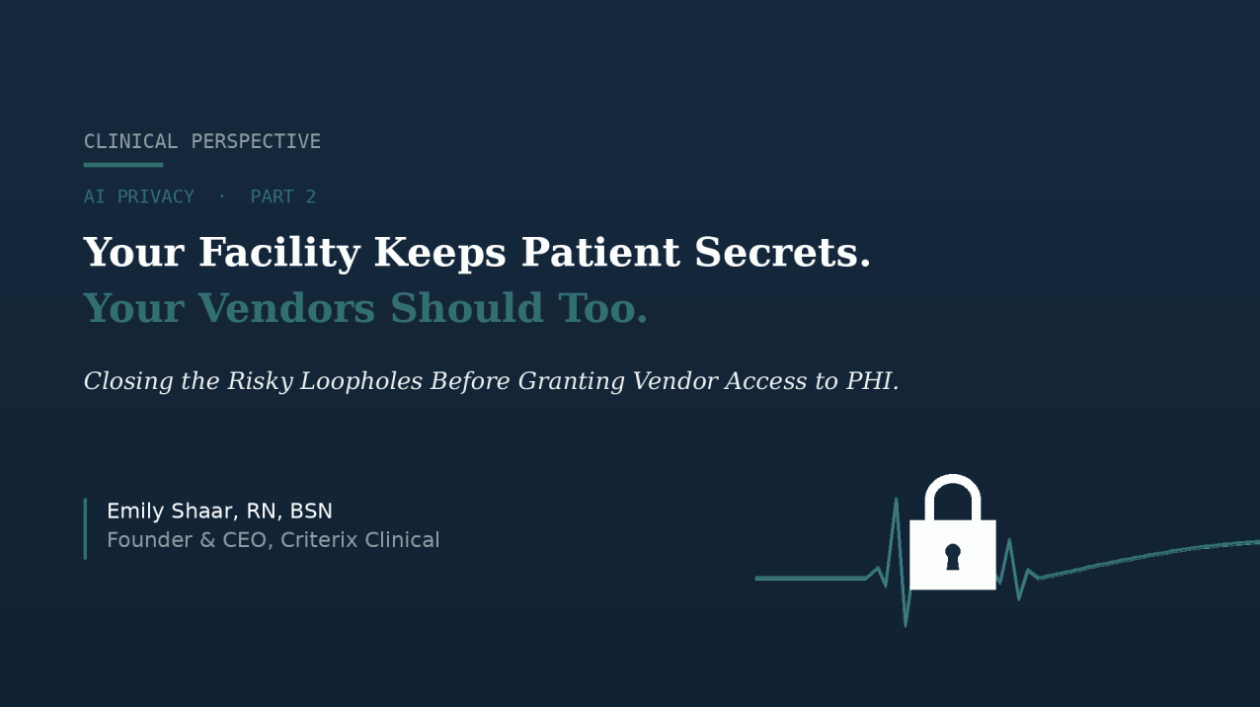
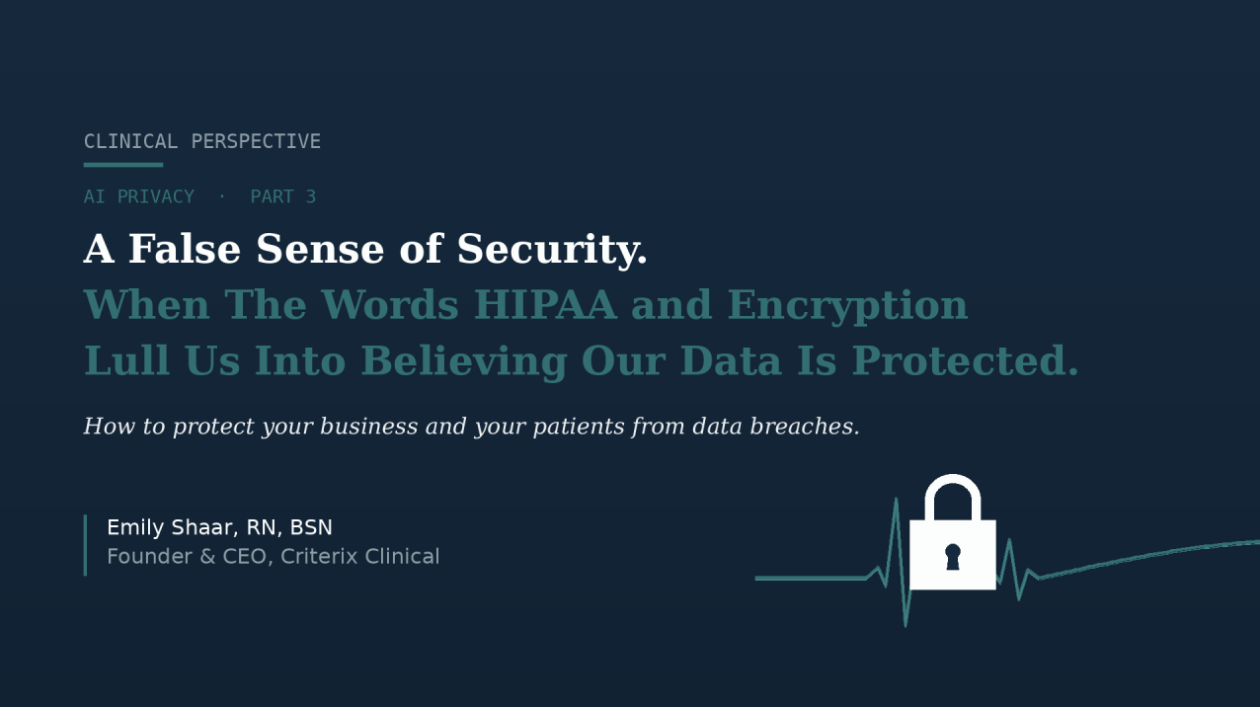
Articles on healthcare AI safety and patient privacy
A series on where AI belongs in patient care, where it does not, and how to protect yourself and your company from privacy breaches and their consequences. Written from the bedside by a clinician who builds both AI and paper clinical support tools, and who has learned to spot and close the gaps that put patients, consumers, and businesses at risk.
Click Each Cover to Read on LinkedIn ↓

FOR HOSPITALS
The discharge list is where the readmission starts
A missed discrepancy at discharge becomes a readmission, a penalty, and a cost you absorb.
54%
of patients had an unintended medication discrepancy in their admission orders
$16,300
average hospital cost of one 30-day readmission
3%
of Medicare base DRG payments at risk under the Hospital Readmissions Reduction Program
Sources: Cornish et al., Arch Intern Med 2005; AHRQ HCUP Statistical Brief #304, 2023; CMS Hospital Readmissions Reduction Program. Full citations in the data sheet.
Pilots and partnerships
Criterix is looking for clinical sites, health systems, and partners to pilot its decision-support tool and the What I Take, and Why medication record. Tell me a little about your organization and what you're interested in, and I'll respond within two business days.
Please do not include patient information in this form.